



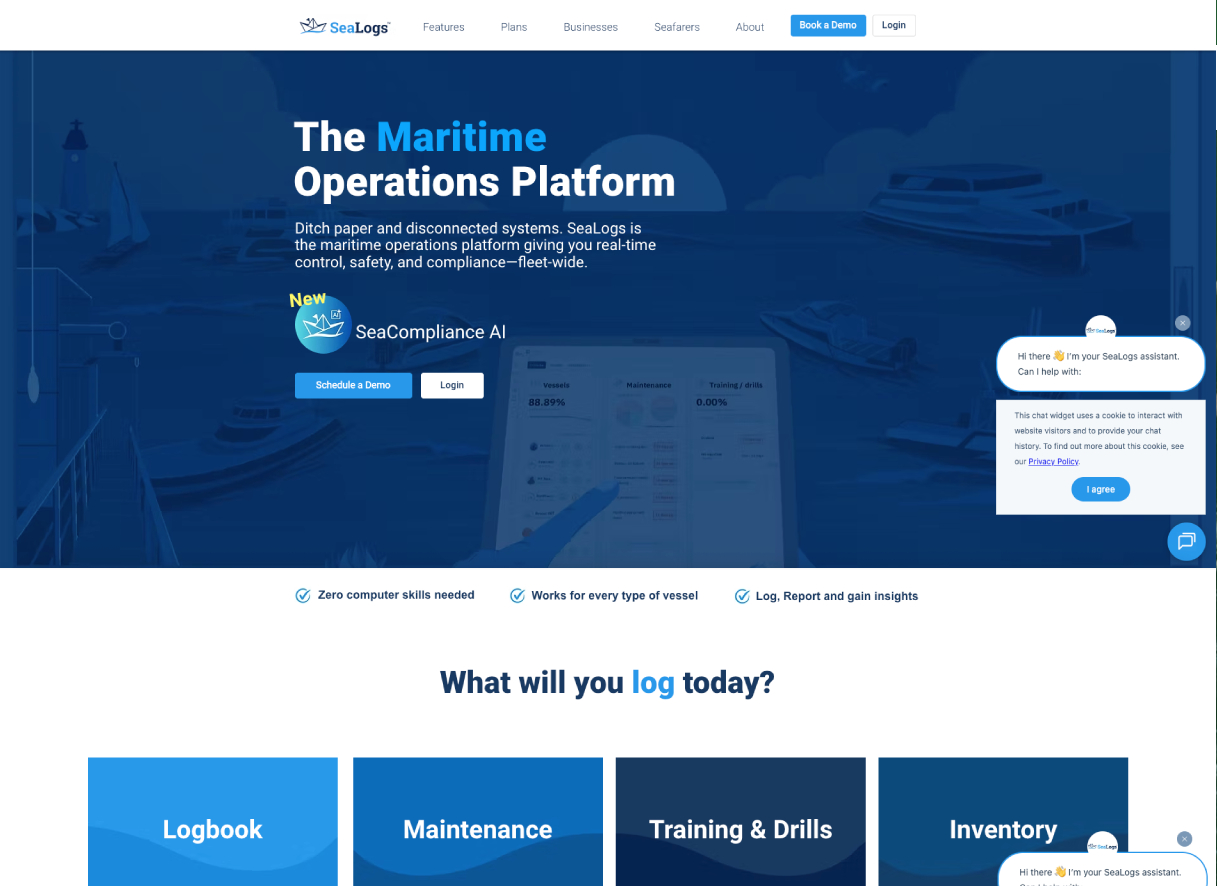
Project Overview
SeaLogs, a maritime operations platform serving vessel operators, ports, ferry services, yachts, workboats, and other marine enterprises, wanted to accelerate growth by boosting organic visibility, attracting high-quality leads (fleet managers, vessel owners, compliance officers), and reinforcing its authority in the the maritime software space. We partnered to deliver end-to-end SEO & content strategy: technical audit & optimization, deep keyword and competitive research tailored to marine / fleet software, content creation (industry guides, case studies, compliance resources), on-page optimization across feature pages, and improved internal linking. Our objective: dominate search for maritime operations software, generate qualified demos, and maximize ROI from organic channels.
Challenges
- Niche, complex domain — maritime operations software is a specialized vertical, with technical jargon (logbooks, compliance, vessel maintenance) and a smaller target audience.
- Fragmented keyword presence — many pages lacked clear, optimized keyword alignment (e.g. “digital logbook software,” “fleet management for vessels,” “maritime compliance system”).
- Technical & structural hurdles — parts of the site had slow performance, missing structured data (schema for software, SaaS, business), weak internal linking between core modules (Logbook, Tasks, Inventory, Reports).
- Content gap in educational / trust content — limited long-form resources, guides, whitepapers, or compliance insights that help decision-makers early in the funnel (e.g. “how to digitize ship logbooks,” “audit readiness for maritime fleets”).
- Lead conversion bottlenecks — site visitors often didn’t convert to demo requests, possibly due to unclear messaging, weak trust signals, or insufficient content alignment with buyer concerns.
Solutions
- Comprehensive Keyword & Competitor Mapping
- Developed detailed keyword maps across features (logbooks, maintenance, compliance, inventory) and user intents (evaluation, comparison, educational).
- Benchmarked direct and indirect competitors in maritime software, noting content gaps, feature positioning, and domain strengths.
- On-Page & Metadata Optimization
- Standardized title tags, meta descriptions, heading hierarchy (H1 / H2 / H3) across feature pages, service pages, and content hub pages, embedding semantic variations and long-tail keywords.
- Added structured data (Product, SoftwareApplication, FAQ, Review) to improve rich results in SERPs.
- Technical SEO & Site Architecture Enhancements
- Improved performance: image optimization, code minification, caching strategies, lazy loading.
- Ensured mobile responsiveness, optimized Core Web Vitals.
- Fixed crawl issues, cleaned up duplicate content, improved canonicalization, and optimized XML sitemap / robots.txt.
- Strengthened internal linking: ensured each module / feature page linked to related content (e.g. from Logbook page to compliance guides, from Inventory to maintenance articles).
- Content Strategy & Thought Leadership
- Built a content hub: whitepapers, how-to articles, compliance guides, case studies, industry trends (e.g. maritime digitization, sustainability in fleets).
- Created interlinked content paths: from top-of-funnel educational pieces to product feature pages and demo CTAs.
- Regularly updated evergreen content, added new articles responsive to evolving industry regulation or trends.
- Conversion & Trust Optimization
- Improved messaging on feature / landing pages: clarified benefits (compliance, safety, audit readiness, cost savings).
- Incorporated trust signals: testimonials, case studies, partner logos, industry certifications.
- Optimized demo / contact forms: simplified fields, A/B tested placement & microcopy, added “Get a Demo” CTAs in strategic spots.